



If you’re researching GemPages AI reviews and alternatives, chances are you’re looking for a platform that covers everything your online store needs, or you simply want to find the tool that best aligns with your goals. Getting the right information before making a decision is the smartest move you can make for your business.
GemPages AI has excellent reviews on Shopify and is a strong contender, particularly for its optimization plans and a wide range of resources to speed up store design.
However, it might not be as helpful if you’re starting your business from scratch. Despite its significant advantages, GemPages is often better for optimization than for taking that first step.
Don’t worry! There are thousands of alternatives out there. We are going to review the best of them so you can create and scale your Shopify store in less time than you ever imagined.
Why BuildYourStore Is the First Tool to Consider

GemPages AI is built for one very specific job: helping you create and improve pages inside a Shopify store faster. Think sections, layouts, product pages, and landing pages that look sharper and convert better, with AI speeding up the “blank canvas” moment.
But that’s also the key limitation in a comparison: GemPages AI assumes the store already exists. So before we even debate which AI builder is better, it’s worth stepping back and asking a simpler question: what stage are you in right now?
If you’re still at the beginning (no real structure yet, no finished storefront, no solid setup), then BuildYourStore is the first tool to consider because it works at a different level. At its core, the platform is designed to build a complete Shopify store from scratch, ready to launch.
Because once you have a full store in place, you can always add specialized tools later, like GemPages AI, to improve specific pages, run experiments, or design high-converting landing pages. But starting with a page builder too early can create a common trap: you invest time polishing page sections while the store is still missing fundamentals (structure, key pages, consistent branding, product setup, and the basic flow a customer will follow).
At a high level, the difference looks like this:
- BuildYourStore gets you a full store foundation (end-to-end setup)
- GemPages AI helps you upgrade and optimize the pages inside that foundation
So if your goal is to launch fast and avoid getting stuck in design decisions too early, BuildYourStore makes sense as the first move. Then, once you’re live and you actually know what needs improvement, GemPages AI becomes a powerful second-step tool for page-level optimization.
Next, let’s look at what GemPages AI does best, because if you already have a store running, it can be exactly what you need.
What Is Gempages AI and Who Is It For

GemPages AI (often branded as “GemAI”) is not an all-in-one store builder. It’s an AI layer inside the GemPages Shopify page builder that helps merchants create and iterate on store pages faster, especially landing pages and product pages.
That framing matters for comparisons, because tools in this category solve a different problem than “build my store for me.” GemPages AI primarily focuses on page-level creation and optimization, while all-in-one approaches focus on end-to-end store setup.
So what does GemPages AI actually do? Today, the clearest “AI” use cases they document are:
- Image-to-Layout: turn a reference image or URL into a ready-to-edit layout (useful for recreating inspiration quickly without building from scratch).
- AI Content Generator: generate on-page copy (headlines, descriptions, section text) inside the editor, guided by product and brand inputs.
In other words, the core problem GemPages AI claims to solve is: “building high-converting pages takes too long when you start from a blank canvas.” Their pitch is speed + flexibility: generate a first-draft layout/copy quickly, then customize it with their no-code editor and templates.
Who Gempages AI is really for in 2026
GemPages AI is a best fit for Shopify sellers who already have (or are actively building) a store and want to:
- Launch or improve landing pages for ads and campaigns
- Upgrade product pages to look cleaner and convert better
- Rapidly create variations for CRO-style iteration (different layouts, sections, messaging)
Who it’s not for (usually): someone who’s still at the “I need a complete store live” stage and wants an end-to-end setup tool. GemPages AI helps you build and refine pages, but it’s still fundamentally a page builder, not a full store generator.
Key Features of Gempages AI
🚧 Page building & customization (core of the platform): GemPages is, first and foremost, a Shopify page builder: you work with a drag-and-drop editor to create and customize pages using sections, blocks, and layouts, without coding.
💻 Templates & sections: Instead of starting from a blank page every time, GemPages leans heavily on prebuilt templates/sections designed for conversion-focused layouts (landing pages, product pages, etc.), which you can then tweak to match your brand.
🤖 AI or automation capabilities:
- GemAI Image-to-Layout: turns an image (or even a URL) into an editable layout you can customize inside the editor—basically a speed boost for design production.
- AI Content Generator (GemAI): generates copy inside a selected section (headlines/paragraphs/etc.) based on your prompt and brand/product inputs—useful for fast first drafts.
🔧 Manual vs automated setup: Even with AI, GemPages is still a builder workflow: the AI helps you generate a starting point faster, but you’re still refining layouts, adjusting sections, and publishing pages manually in the editor.
🦾 Integrations & compatibility: GemPages is built to live inside the Shopify ecosystem as an app. Compatibility is primarily about working with your Shopify store + theme setup, and then adding other apps around it as needed.
Pros and Cons of GemPages AI
✅ Fast page creation with drag-and-drop + templates (strong for landing/product pages).
✅ Image-to-Layout is genuinely practical when you already know what you want the page to look like (reference-based building).
✅ AI copy generation helps unblock writing for section-level content (good for first drafts).
❌ Not an all-in-one store setup tool: it optimizes/builds pages inside a Shopify store, rather than creating a full store foundation end-to-end.
❌ AI usage is plan-limited (e.g., Image-to-Layout sections/month and “AI-generated content rewrites/month” depending on tier).
❌ Beginners can over-invest in design too early: if your store fundamentals aren’t ready, a page builder can turn into polishing mode before you have a solid storefront flow.
Gempages AI Pricing Overview
GemPages’ pricing is tiered, with a free entry option and paid plans that expand publishing limits, templates/sections, and AI allowances.
- Free: $0 (includes 1 published page; GemAI Image-to-Layout up to 60 sections).
- Build: $29/month (includes unlimited publish slots; AI content generation allowance; GemAI Image-to-Layout up to 300 sections).
- Optimize: $59/month (adds more advanced capabilities + unlimited Image-to-Layout sections, and higher AI content limits).
Gempages AI vs BuildYourStore
Let’s compare these two the right way, because they’re not trying to win the same race.
As we said, GemPages is a page-building and optimization tool for Shopify. BuildYourStore is a store foundation tool; it’s meant to get you from nothing to a sellable store fast.
So instead of a vague “which one is better,” the real question is: what do you need first?
Setup speed
- BuildYourStore: faster for starting from zero because it’s focused on getting an entire store structure ready without you having to assemble everything manually.
- GemPages: fast for building pages, but it assumes the store already exists and you’re now improving specific pieces.
Time to live store
- BuildYourStore: It usually wins here, because the end goal is a complete live store, not just nicer pages.
- GemPages: It can speed up publish-ready pages, but if you still don’t have a proper store foundation, it won’t solve that missing piece.
Skill level required
- BuildYourStore: More beginner-friendly if you don’t want to make 100 decisions upfront (layout, key pages, structure, etc.).
- GemPages: Beginner-friendly as a builder, but it rewards people who already know what they’re trying to improve (conversion, landing pages, product page structure).
Store completeness
This is the clearest difference:
- BuildYourStore: full store (foundation first).
- GemPages: pages inside a store (enhancement layer).
➡️ If your store isn’t fully real yet, a page builder can turn into a time sink: you end up perfecting a landing page while your overall store flow is still shaky.
AI & automation depth
- BuildYourStore: AI produces a complete starting point (store-level outcome).
- GemPages AI: AI helps you draft layouts and content faster, but the workflow is still mostly “you build + you tweak + you publish.”
Long-term scalability
- BuildYourStore: acts like a foundation, something you build on top of. Once the base is solid, you can add specialized tools later.
- GemPages: scales nicely as a specialized conversion tool (more pages, more variants, more campaigns), but it’s not meant to be the foundation by itself.
In Short:
➡️ If your priority is launching a complete store quickly, BuildYourStore should be the first move.
➡️ If your priority is optimizing pages inside an existing Shopify store, GemPages AI makes a lot of sense, especially for campaign landing pages and product pages.
Best Alternatives to Gempages IA
Here are real, solid alternatives, starting with the one that changes the whole framing.
BuildYourStore (best overall alternative)

BuildYourStore uses AI to build a complete store ready to sell in less than 5 minutes. It is the ideal solution for entrepreneurs who don’t want to spend hours designing every section.
BYS selects the niche, imports winning products, and automatically configures a professional design, allowing you to move directly to the marketing and sales phase without any technical friction.
GemPages AI helps you create/optimize pages inside a store; BYS is about getting the store itself ready first.
Shogun

Shogun has positioned itself as the premium tool for brands that are already scaling. Its recent focus on AI enables automatic generation of text content and SEO suggestions, saving hours of editorial work.
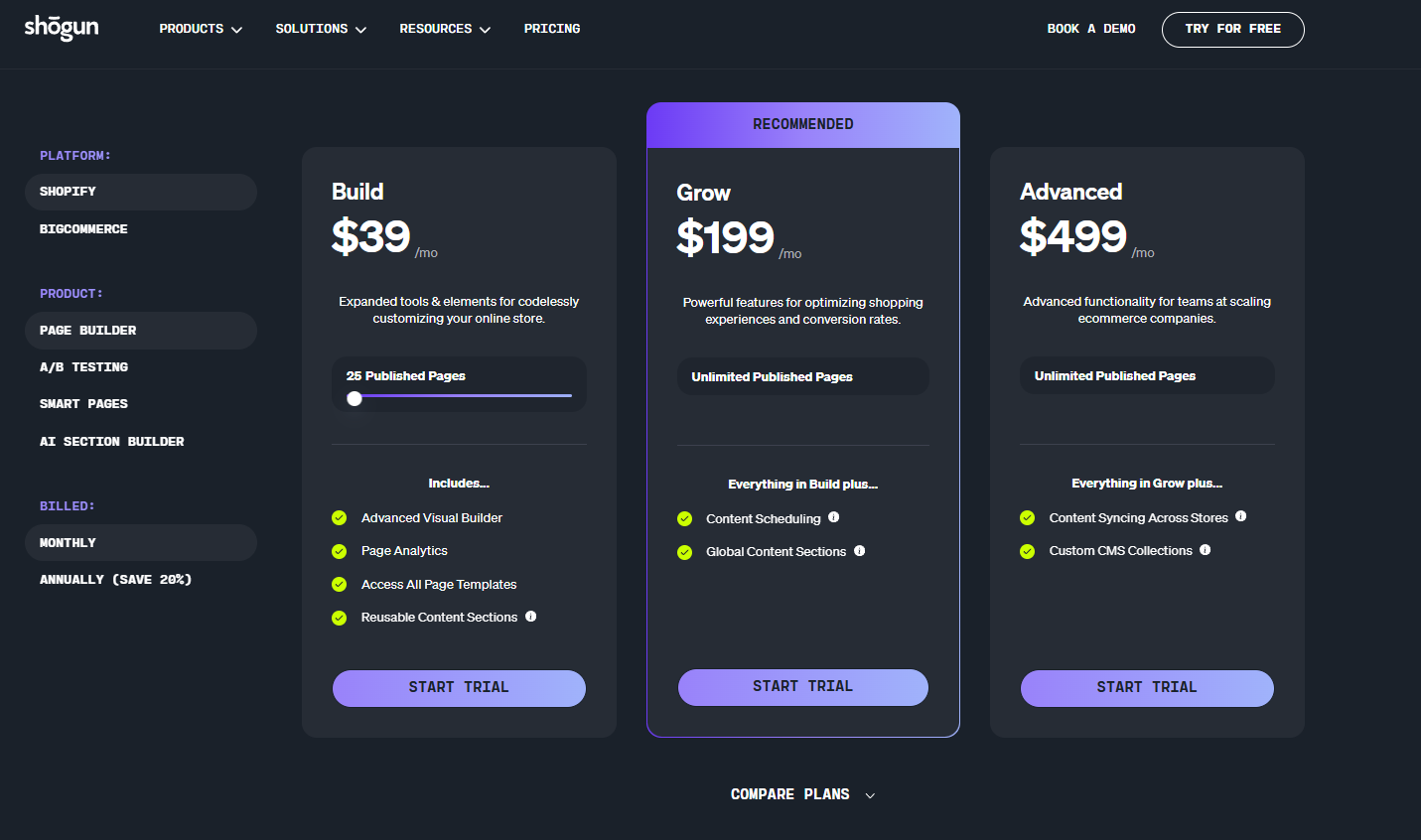
Although its price point is higher, the robustness of its platform and the integrated A/B testing tools justify the investment for high-traffic stores looking to optimize every percentage point of their conversion rate.
Best for: Marketing teams + polished page workflows
👉 Want to know whether Shogun beats starting with a ready-made AI store? Take a look at our Shogun vs. alternatives breakdown before deciding.
PageFly

PageFly is likely the most direct competitor to GemPages. It stands out for having one of the most extensive template libraries on the market and an extremely fluid drag-and-drop editor.
What truly makes it shine is its integration ecosystem; virtually any Shopify review or upsell app has a native element within PageFly. It is the preferred choice for users who need granular control over every mobile element of their store.

Best for: Flexibility + starting cheap
EComposer

EComposer has rapidly become one of the most popular alternatives to GemPages due to its impressive speed and modern interface.
Unlike older page builders that can sometimes bloat your store’s code, EComposer is built for performance, ensuring that your custom designs don’t sacrifice loading times.
It offers a massive library of pre-made layouts and specific “sections” that you can mix and match, giving you the flexibility of a high-end agency without the hefty price tag.

Best for: Templates + AI tools inside the builder
Replo (best for “high-end” landing pages + performance-minded builds)
Replo is the go-to alternative for high-growth Shopify stores that need the precision of a professional design tool like Figma but directly within the Shopify ecosystem.
Replo offers an ultra-powerful, “low-code” environment that gives designers and developers total control over every pixel and CSS property. It is specifically built for performance and speed, ensuring that even the most complex, asset-heavy landing pages load instantly, which is a critical factor for brands running high-volume paid traffic.
Best for: Professional Design
When Gempages AI Makes Sense, And When It Doesn’t
GemPages AI is a great tool when you use it for the job it was designed to do. And it’s a frustrating one when you expect it to solve a different problem.
GemPages AI makes sense if…
- You already have a Shopify store (or at least the basics are set up). GemPages AI shines when you’re improving what exists, not when you’re still trying to assemble the foundation.
- Your main goal is better pages, not a store from scratch. Landing pages for ads, cleaner product pages, homepage sections that look more intentional—this is its comfort zone.
- You want to move faster than “blank canvas mode.” The AI features are helpful for getting a first-draft layout or copy, then customizing it in the builder.
- You’re running campaigns and need iteration. If you’re constantly launching promos, testing angles, or building page variants, a page builder with AI support can save real time.
GemPages AI doesn’t make sense if…
- You need a complete store, end to end, and you’re starting from zero.
- GemPages AI won’t build the whole store foundation for you. It helps you create and optimize pages inside a store, so if the store isn’t ready, you’ll feel like you’re building on sand.
- You’re trying to solve e-commerce with one tool. It’s not an all-in-one launch system. It’s a specialized layer: powerful, but not the whole stack.
- You tend to over-polish the design before it’s live. This is the classic trap: you spend days perfecting sections while the essentials are still missing (store structure, navigation, key pages, product setup, and a clean customer flow).
If your priority is launching a fast, sellable store, start with BuildYourStore as your baseline.
If your priority is upgrading and testing pages inside an existing Shopify store, GemPages AI is a smart pick.
Frequently Asked Questions
Is GemPages AI good for beginners?
Yes, as long as you’re using it for the right stage. GemPages AI is beginner-friendly in the sense that it’s drag-and-drop and helps you generate layouts/copy faster. But it works best when you already have a Shopify store foundation, and you’re trying to improve specific pages (product pages, landing pages, homepage sections). If you’re starting from absolute zero, it can feel like you’re optimizing before you’re even ready.
Can I build a full Shopify store with GemPages AI?
Not in the all-in-one store generator sense. GemPages AI helps you create and customize pages inside a Shopify store, but it doesn’t replace the full store setup process (overall structure, core pages, navigation, catalog decisions, etc.). Think “page builder + AI assistance,” not “complete store builder.”
Is GemPages AI better than BuildYourStore?
If your goal is to launch a complete Shopify store quickly, BuildYourStore is usually the better fit because it focuses on the store foundation end-to-end. If your goal is to optimize pages within an existing store, GemPages AI is the better tool because it’s built for page-level creation and iteration.
Does GemPages AI require design or coding skills?
No coding required. Design skills help (especially if you want premium-looking pages), but they’re not mandatory. The AI features and templates can give you a strong starting point, and you can fine-tune spacing, sections, and messaging with the visual editor.
What is the best alternative to GemPages AI?
If you want a complete store foundation, the best overall alternative is BuildYourStore (different category, but often the better starting point). If you specifically want other page builders, strong real options include Shogun, PageFly, EComposer, Replo, and Zipify Pages.
Can I use GemPages AI together with other Shopify tools?
Yes. GemPages is typically used as part of a Shopify stack. Many merchants use it alongside theme tools, email/SMS marketing platforms, review apps, upsell apps, and analytics/CRO tools. The main thing is keeping your setup clean, so you don’t end up with overlapping tools doing the same job.
Is GemPages AI worth the price in 2026?
It’s worth it if page creation and iteration are a real bottleneck for you, for example, if you’re running ads, launching promos often, or constantly improving product pages. If you’re a beginner who just needs a store live, it may be smarter to start with a foundation-first approach (like BuildYourStore), and only pay for a page builder once you’re actually optimizing and testing.
Final Verdict: Is Gempages AI Worth Using in 2026?
GemPages (and its AI features) is worth using in 2026 if you’re already operating inside Shopify and your main challenge is building better pages faster. It’s especially useful for stores that:
- Run paid traffic and need landing pages that convert
- Want stronger product pages without custom coding
- Need to iterate quickly (new promos, new layouts, new messaging)
In that scenario, GemPages is a practical speed-and-control tool: it helps you move past the blank canvas and ship pages you can actually test.
But here’s the clean limitation: GemPages is still a page builder. It improves what exists; it doesn’t solve the “I need a complete store live” problem on its own.
So if you’re starting from zero (or your store foundation is still shaky), BuildYourStore remains the safest default choice. It gets you to the outcome that matters first: a complete, functional Shopify store that’s ready to launch.
Then, once you’re live and you know what needs improving, adding a tool like GemPages makes a lot more sense.
Interested in more GemPages alternatives? Check out these articles:


